
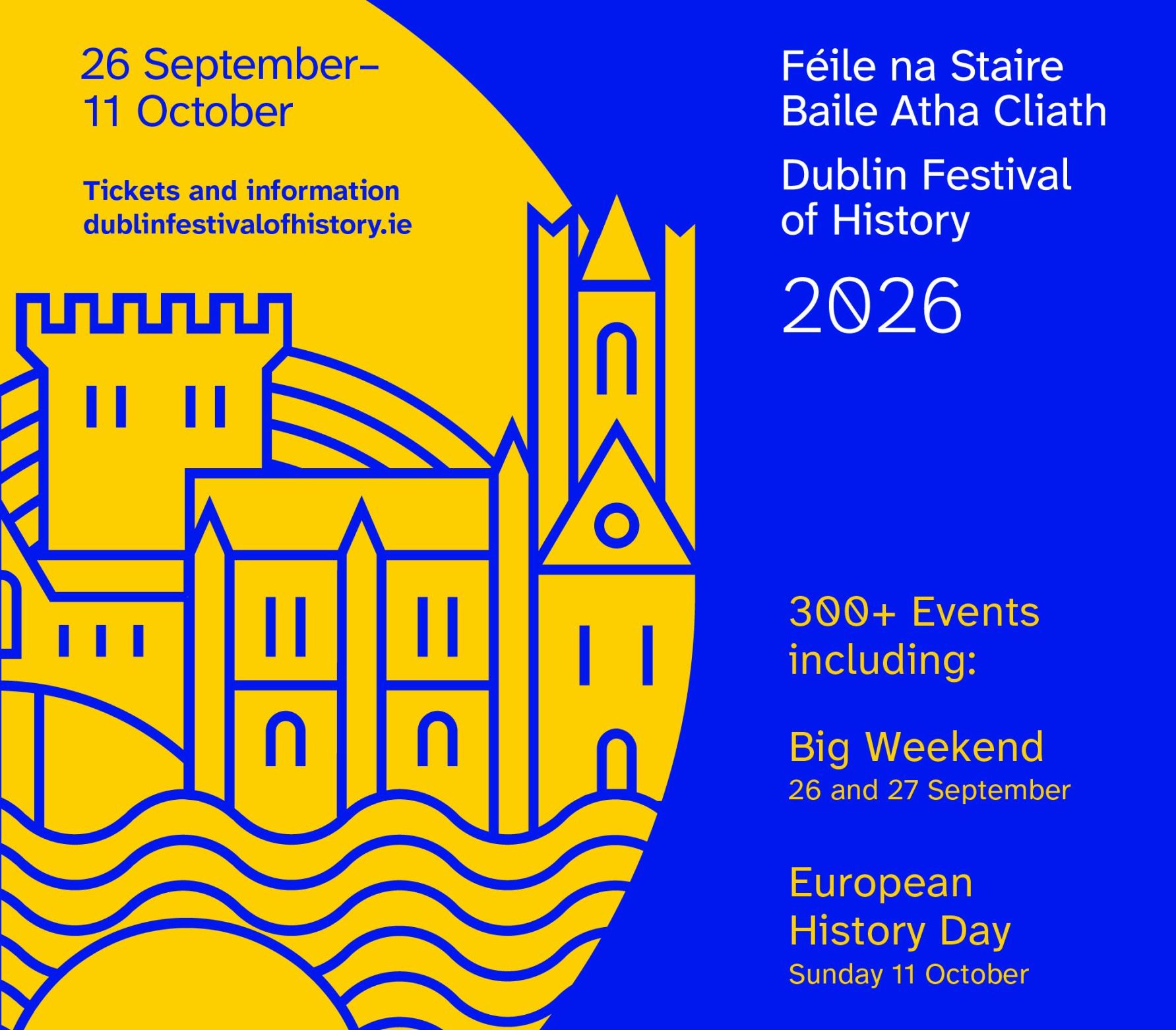
Dublin Festival of History 2026
27 August 2026
The Dublin Festival of History will run from 26 September to 11 October 2026.
The Dublin Festival of History is an annual free festival, brought to you by Dublin City Council, and organised by Dublin City Libraries, in partnership with the Dublin City Council Culture Company.
Now in its fourteenth year, the festival has built a reputation for shining a fresh perspective on history and its importance in our everyday lives, attracting best-selling Irish and international historians to Dublin for a high-profile programme of history talks and debate each Autumn.
Book Your Free Tickets on Eventbrite
A Forgotten Dublin Hospital: The Pigeon House Hospital
SOLD OUT
Monday 28 September – 1:00pm
Speaker: Susan Mullaney
Description:
Few people now realize that a hospital existed on the Poolbeg Peninsula for fifty years during the 20th century. It was initially established as an isolation hospital during the smallpox epidemic in 1903. Having secured funding in the USA, the Womens National Health Association, led by Lady Aberdeen, reopened it as a Tuberculosis hospital in 1910, and it was the first Tuberculosis sanatorium in the city of Dublin. The area has now become an industrial zone and memories of the hospital are fading rapidly. This talk will describe how the hospital was established, and trace its history until it closed in the 1950s, describing the lives of those who both lived and worked there.
Guinness and the River Liffey
Thursday 1 October – 1:00pm
Speaker: Eibhlin Colgan
Description:
The Guinness Brewery has been a part of the fabric of Dublin city since its foundation in 1759. From the first recorded export to England in 1796, Guinness has also been closely associated with Dublin Port. This talk, by Eibhlin Colgan, will explore how Guinness used the River Liffey and Dublin Port to export stout around the world, creating one of Ireland’s first global brands.
History Ireland Hedge School – Captain Bligh: Hero or Villain?
SOLD OUT
Saturday 3 October – 3:00pm
Speakers: Dr David Murphy (Maynooth University), Rob Goodbody (President of IHAI) and Lar Joye (Port Heritage Director)
Moderator: Tommy Graham (with Angela Byrne)
Description:
Few figures in maritime history have generated as much debate as Captain William Bligh. Best known for the infamous Mutiny on the Bounty, Bligh has been portrayed variously as a tyrant, an exceptional navigator, a reformer, and a victim of circumstance. But how much of what we think we know is based on historical fact, and how much has been shaped by novels, films and popular culture?
This Hedge School brings together historians and maritime experts to examine the life, career and legacy of one of the most controversial figures of the Age of Sail. The discussion will explore Bligh’s role in the Royal Navy, his involvement in the Bounty voyage, his connection to the political and social upheavals of the late eighteenth century, and his lesser-known contribution to the development of Dublin Port. Join us for a lively debate on the man behind the myth and the enduring question: was Captain Bligh a hero or a villain?
Selling Leisure: Urban Electrification in 20th Century Dublin
SOLD OUT
Monday 5 October – 6:00pm
Speaker: Jaz Burns
Description:
In this lecture, Jaz Burns, Archives & Heritage Manager for ESB, will explore the industrial heritage that transformed Dublin during the twentieth century through the arrival of electricity. Drawing on the rich visual collections of the ESB Archives, Jaz will examine the infrastructure that powered the city’s growth, from iconic landmarks such as Poolbeg Generating Station to the network of substations and support structures that brought electricity into homes, businesses and industries. The lecture will highlight how these often-overlooked buildings helped shape the modern Dublin we know today and supported the development of the city and port throughout the twentieth century.
The Sinking of the Tayleur
Tuesday 6 October – 5:00pm
Speaker: Edward J. Bourke
Title: The Sinking of the Tayleur
Description:
On 28 January 1854, the emigrant sailing ship Tayleur was wrecked off Lambay Island on its maiden voyage from Ireland to Australia. Carrying hundreds of passengers seeking a new life abroad, the disaster became one of the deadliest maritime tragedies in Irish waters.
In this lecture, Edward J. Bourke, author of Bound for Australia: The Loss of the Emigrant Ship Tayleur, explores the events leading up to the wreck, the desperate efforts to save those on board, and the role played by the communities of Rush, Skerries and Malahide in the rescue of survivors. Drawing on extensive research, Bourke sheds light on the human stories behind this tragic voyage and its lasting place in Ireland’s maritime history.
Defences of Dublin Port
Wednesday 7 October – 5:00pm
Speaker: Lar Joye
Description:
Join Port Heritage Director Lar Joye for a fascinating journey through the military history of Dublin Port. From Napoleonic-era fears of invasion to the challenges of two World Wars, this lecture explores the forts, batteries, watchtowers, searchlights and defensive networks that once protected Ireland’s principal port. Drawing on maps, photographs and archival records, Lar will reveal how Dublin Port became one of the most heavily defended stretches of coastline in the country and uncover the stories of the soldiers, sailors and civilians who served there. Discover the remarkable legacy of these often-overlooked defences and their lasting impact on Dublin’s maritime landscape.
Dublin’s Domestic Architecture
Thursday 8 October – 1:00pm
Speaker: Charles Duggan
Description:
Dublin’s domestic architecture evolved from 16th-century timber cage-work houses with steep roofs and timber-framed interiors, followed by Dutch Billy gabled houses and, later, the formal Georgian grandeur of Henrietta Street. These traditions chart the city’s shift from medieval irregularity to classical order. From the late 19th century onward, workers’ housing emerged through extensive suburban estates designed by the Dublin Corporation Architects’ Department.